
Herman Hummel, Hanie Matajinimvar, Dominga van der Vliet, Vivien Laros, Veronika Poškut, Alissa Lotzkes (HuFoSS, Roosendaal, the Netherlands)
Between December 2025 and January 2026, the third and final round of stakeholder consultations within Marine SABRES WP2 was carried out across seven case study locations. Through interactive workshops the stakeholders shared their viewpoints, appreciation, and suggestions for co-design on the semi-final tools produced by the various Work Packages (WPs) in the project. At the workshops the stakeholders tested, after a short introduction, the functionality of the tools in hands-on exercises. Three tools that were most developed for a wider audience, i.e., the Social-Ecological Systems – Decision Support System (SES-DSS), the Governance tool, and the Toolbox (which is developed together with the sister-project MARBEFES), were tested during half a day. At the end of each test the stakeholders their opinion and suggestions were requested by means of a Mentimeter.
A total of 54 stakeholders participated in the consultation round, of which most belonged to the authorities, academic researchers, and private enterprises, and to a lesser amount to MPA managers, musea, NGOs and the public at large (Fig. 1).
The high number of authorities, i.e. policy-makers and managers, followed by researchers, reflects the project’s objective of engaging the groups most likely to apply the tools in marine management and decision-making.
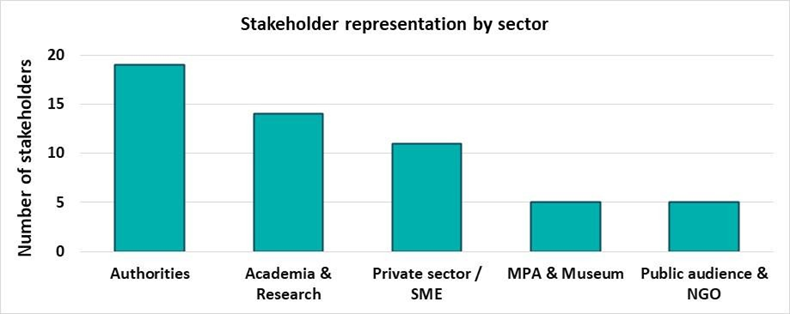
Figure 1. The number of stakeholders heard in the third round of stakeholder consultations
The overall appreciation of all the tools was at all locations very satisfactory and consistently high,
i.e. at a level of about 4 on a scale of 5 (Fig.2).. The expected use of the tools by others was scored a bit higher than their own use, which may be due to the fact that some stakeholders, as the public at large, probably will not use the tools so much as the professionals as e.g. the policy-makers and researchers.
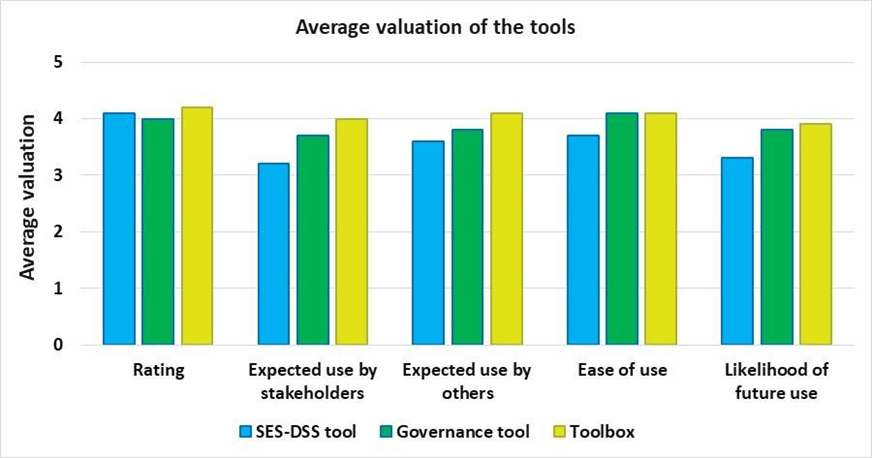
Figure 2. Scores given by stakeholders in the regional workshops for the tools on a scale from 0 to 5. From left to right: How much they appreciated the tools (rating), to what degree they expect to use the tools, to what degree they expect others will use the tools, how easy the tool was to use, and how likely they will use the tool in the future.
The stakeholders indicated especially the potential of the tools for information, social-ecological system exploration, communication, and decision-making processes. Nevertheless, the stakeholders indicated frequently the high complexity and technical challenges of the tools, and therefore advised the tools should have a more intuitive and user-friendly user navigation, a description or translation in the local language, and a more locally directed approach for the steps to be made in the tools instead of an AI guided approach. Moreover, they indicated the need to secure that the information is up to date in the Toolbox and the Governance tool, in order to keep those tools “alive in time” and “dynamic”. To this end, the stakeholders suggested to install working groups for editing the tools.
Nonetheless, the consistently high scores across all categories suggest that stakeholders recognise the value of the tools developed in Marine SABRES and perceive great potential for their future use. Thereby the stakeholder workshops have proven to be helpful for the further co-design of these tools and in advancing the overarching goals of the Marine SABRES project
To finalise the third consultation round, an Overarching Stakeholder Workshop was organised in Zandvoort, the Netherlands, in early spring 2026, bringing together 20 stakeholders, 11 tool developers, and 11 general researchers, from also the sister-project MARBEFES, covering thereby relevant European coastal areas from north to south and from east to west. During the workshop, participants tested the semi-final versions of the tools, exchanged experiences from the regional consultations, and provided additional feedback on the applicability of the tools. The tool-developers could directly on-the-spot process the feedback to improve the tools, and show the revised tools the next day to the stakeholders for further amendments. Thanks to this co-design process whereby the stakeholders offered constructive recommendations regarding usability, transparency, and practical implementation, the tools were finally very positively received, with a high score of again around 4 out of 5 points (Figure 3).
In conclusion, the regional stakeholder workshops as well as the Overarching Stakeholder Workshop served as an important final co-design step before the tools enter their final development phase.

Figure 3. Scores given by stakeholders for the tools in the Overarching StakeholderWorkshop, early spring 2026, on a scale from 0 to 5. From left to right: How much they appreciated the tools (rating), to what degree they recommend the tools to be used by others, and how user-friendly the tools are.
Photos from Marine SAbres research sites and workshops. (all copyright with HuFoSS, yet for the newsletter free to be used, when indicating @HuFoSS)


